What Is Natural, Organic Salt and Why Is It Healthier Than Regular Table Salt?
Ever notice how the salt shelf at the grocery store has gotten weirdly crowded? There’s still that blue box of iodized table salt everyone grew up with, but now it’s sharing shelf space with bags that say “sea salt,” “natural salt,” even “organic salt” right on the front. Marketing gimmick, or is there something to it? Turns out there’s actually a real difference.
Below, we’ll get into what organic salt really means, how it stacks up against the table salt most kitchens default to, and why so many people have started reaching for pure healthy organic salt without really talking about it.
What Is Organic Salt?
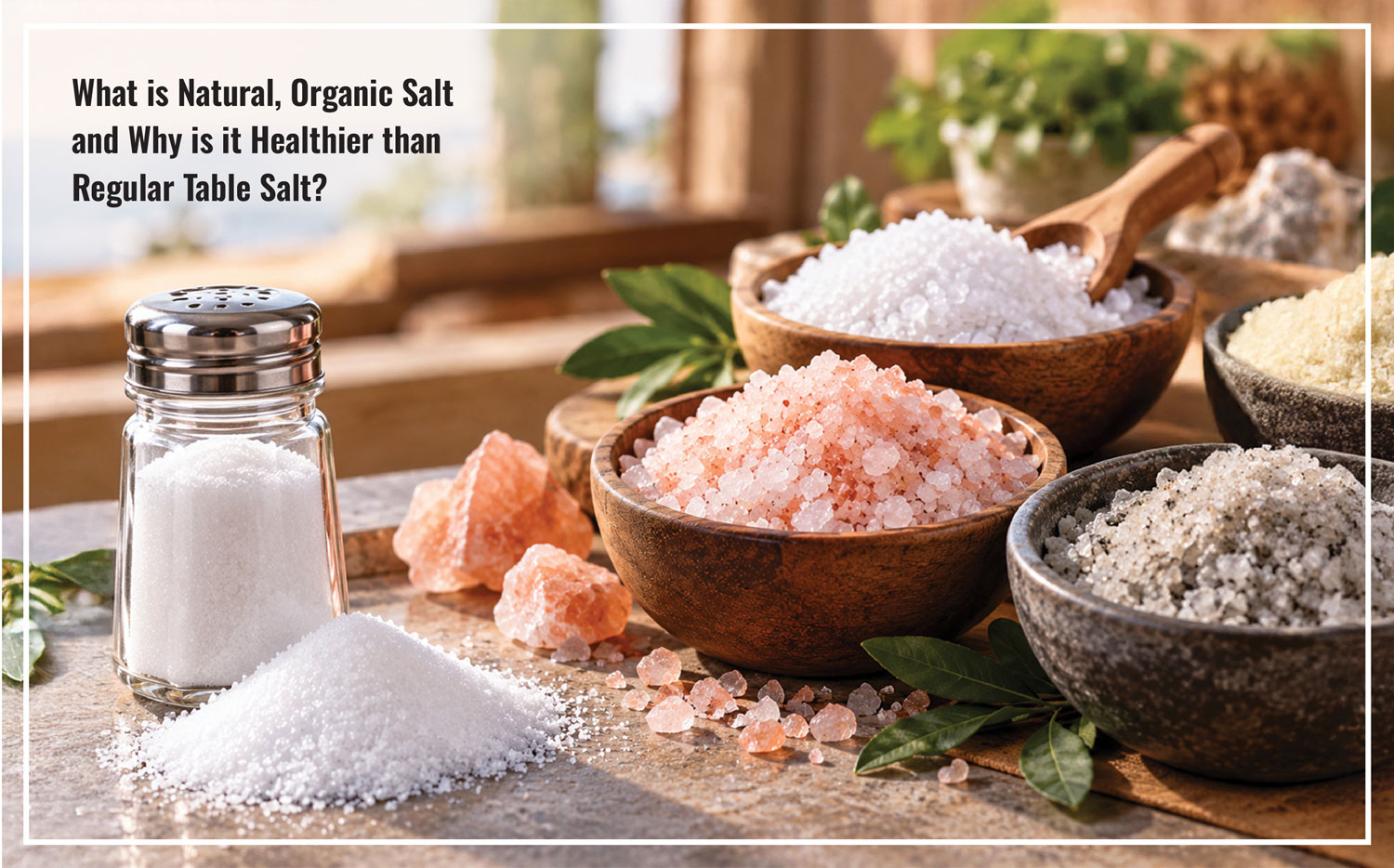
Organic salt isn’t complicated once you break it down. It’s salt that hasn’t gone through the wringer, no synthetic chemicals thrown in, no bleach, none of the industrial steps regular salt goes through on its way to your pantry. Table salt loses its trace minerals along the way. Organic salt just… keeps them. It usually comes from a handful of sources:
- Sea salt – pulled straight from evaporated seawater
- Rock salt (halite) – mined from deposits that have been sitting underground for thousands of years
- Himalayan pink salt – comes out of Pakistan, known mostly for its mineral makeup and that pink color
Skip the heavy refining and you end up keeping over 80 trace minerals, magnesium, potassium, calcium, iron, the whole list. That’s honestly why organic salt looks different too, that pink or grey tint isn’t dye, it’s just minerals doing their thing instead of getting stripped out. A lot of brands slap “natural salt” on the label instead, and fair enough, it’s pretty much stayed the way it came out of the ground or the sea.
So What Actually Makes Salt "Organic"?
This is where people usually get a little confused. Organic salt specifically means no synthetic chemicals, no artificial additives, no bleaching at any point in the process. For something to genuinely earn the label organic salt, a few things have to be true:
- No anti-caking agents like sodium ferrocyanide mixed in
- Never chemically bleached, never blasted with extreme heat
- Harvested the old way, without industrial shortcuts
- No added iodine or synthetic stabilizers unless it’s naturally occurring
See a bag labeled Healthy Organic Salt? That usually means it went from wherever it was harvested straight to the shelf, barely handled along the way. Honestly, that’s the real dividing line between actual organic salt and something that just borrows the word “natural” because it sounds good on packaging.
How Table Salt Actually Gets Made
Worth knowing why organic salt gets so much credit, so here’s the quick version of what regular table salt goes through before it ever reaches your shaker.
It starts out mined like most salt does, then gets hit with extreme heat to knock out moisture and “impurities.” Except that same heat wipes out the trace minerals organic salt manages to hold onto. From there, manufacturers typically toss in:
- Anti-caking agents so it doesn’t clump up
- Iodine in the iodized versions, mainly to prevent deficiency
- Bleaching agents sometimes, just to get that bright white color
End result? Basically pure sodium chloride, close to 99% of it, a far cry from where it started. That processing gap is exactly what’s pushing people toward organic salt and pure healthy salt, not just for the salt itself but as part of eating less processed food in general.
Organic Salt vs. Table Salt: A Quick Comparison
Factor |
Pure Healthy Organic Salt |
Regular Table Salt |
|---|---|---|
Processing
|
Barely touched, traditional methods
|
Heavily refined, heat-treated
|
Trace minerals
|
80+ natural minerals intact
|
Almost none left
|
Additives
|
Anti-caking agents, sometimes bleach
|
None
|
Sodium content
|
Slightly lower per volume
|
Very concentrated
|
Flavor
|
Layered, mineral-rich
|
Sharp, one-note
|
Color
|
Pink, grey, off-white
|
Bright white
|
Lay it out side by side like that and it’s not even close. Organic salt comes out ahead on nearly every point, even though at the chemical level both are still mostly the same compound.
Why People Think Organic Salt Is Healthier
Wait, Is Organic Salt Actually Lower in Sodium?
Picking a Decent Pure Healthy Organic Salt
Out shopping for organic salt? A handful of things worth checking before you buy:
- Certified organic labeling, wherever that applies
- Short ingredient lists, ideally just the word “salt” and nothing else
- Clear sourcing, brands willing to actually say where it’s harvested
- Unbleached, unrefined wording somewhere on the packaging
- Natural color variation, pink, grey, off-white, never stark white
Honestly, reading the fine print is the fastest way to tell genuine pure healthy organic salt apart from something that’s just riding on the word “natural” without meeting any real bar.
How People Actually Use It Day to Day
- Finishing touches – sprinkled on right at the end, salads, grilled meat, wherever you’ll actually taste it
- Baking – weighing out healthy organic salt instead of scooping it, since crystal size varies more than table salt does
- Brines and pickles – natural salt dissolves clean, nothing extra in there to mess with flavor or texture
- Daily cooking – a small dish of pure healthy salt kept right by the stove for pinch-as-you-go seasoning, a habit a lot of home cooks pick up over pre-measured iodized salt
Bottom Line


FAQs
Natural salt is salt that’s barely processed after it’s taken from the ground or sea. It skips the heavy refining table salt goes through, so it keeps its trace minerals and natural color instead of turning bleached white.
Mostly they overlap. Organic salt is natural salt that meets a stricter bar: no synthetic chemicals, no bleaching, nothing added. So all organic salt is natural salt, but not every “natural” salt qualifies as organic.
Pure healthy salt keeps trace minerals like magnesium and potassium that get lost in heavy refining. It also skips the anti-caking and bleaching agents found in most table salt. Less taken away, nothing extra added.
For everyday cooking, fine-ground organic salt or Himalayan pink salt works well since both dissolve easily. For finishing a dish, a coarser healthy organic salt adds more texture and flavor per pinch.
It costs more upfront, but its stronger flavor means you often use less per dish, so a bag lasts longer than you’d expect. If you cook often, the price evens out pretty quickly.
It can if you measure by the spoon. Organic salt crystals vary in size, so a spoonful won’t match the amount the recipe expects. Weighing it with a kitchen scale fixes the problem completely.