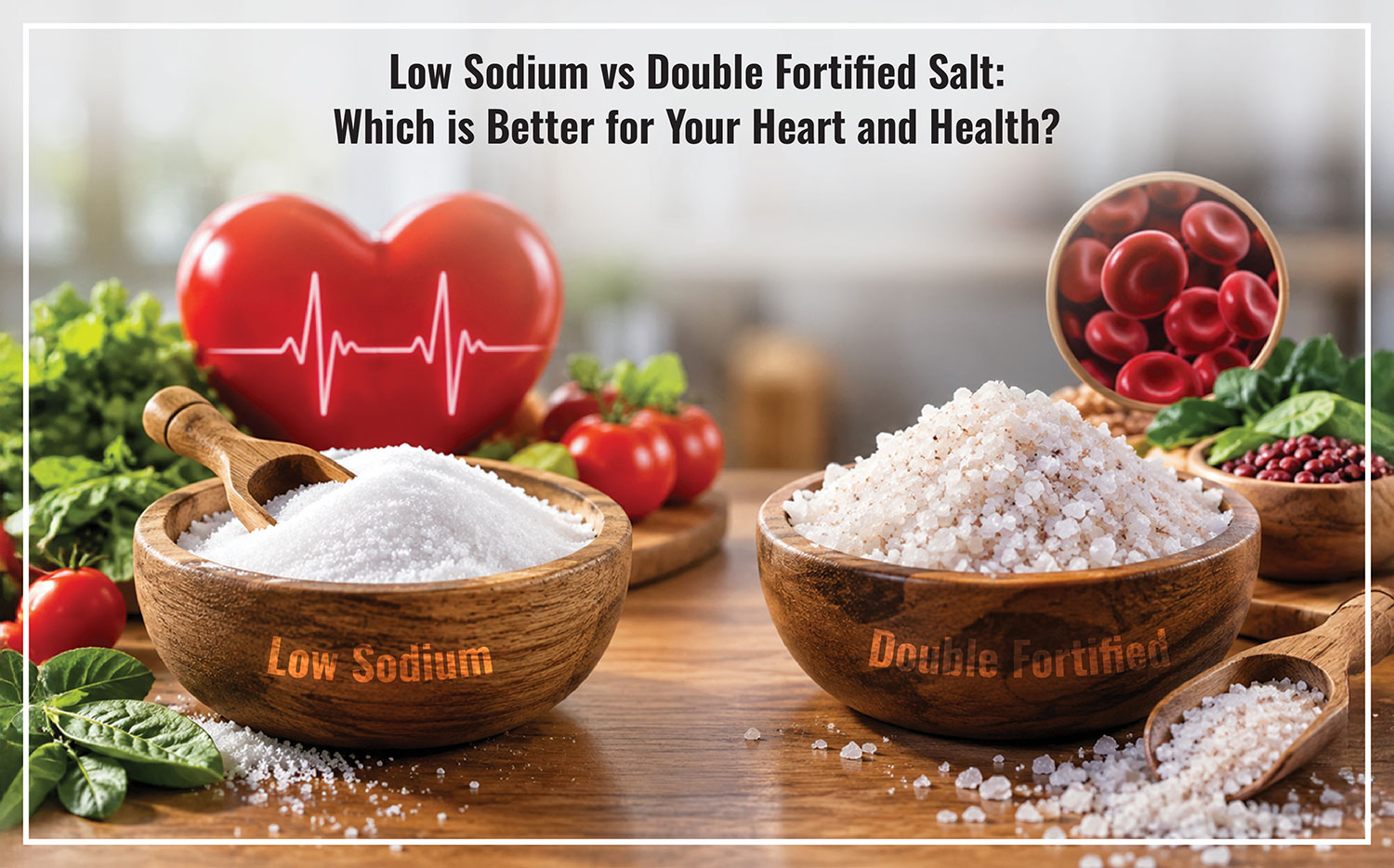
Low Sodium vs Double Fortified Salt: Which Is Better for Your Heart and Health?
Walk down any supermarket salt aisle now and it’s not just plain and iodised anymore. There’s low sodium salt on one shelf. Double fortified iodised sea salt on another. Both get marketed as the healthier pick. Healthier for what, though? That’s the part nobody explains on the packet.
Because low sodium salt and double fortified iodised sea salt aren’t solving the same problem. One is built around your heart. The other’s built around nutrient gaps iron and iodine. Assuming one automatically replaces the other is where most of the confusion starts.
What Is Low Sodium Salt, Really?
Low sodium salt swaps out a chunk of the sodium chloride in regular table salt for potassium chloride instead. Less sodium going in, a bit more potassium and potassium happens to work in the opposite direction sodium does on blood pressure. Sodium tends to push it up. Potassium tends to help bring it down.
That’s the entire pitch behind low sodium salt. Same salty taste on the tongue, smaller sodium hit for the body. It’s exactly why it shows up so often in diet plans doctors hand out to hypertension patients.
What Double Fortified Iodised Sea Salt Actually Does
The goal there is completely different, closing gaps in iodine and iron, not managing blood pressure. Two products, two different jobs. That’s the piece people miss when they compare the two side by side.
So Which One Actually Helps Your Heart?
If heart health and blood pressure are the concern, low sodium salt is the one doing that work. Cutting sodium intake is one of the most well-established ways to bring blood pressure down, especially in people who already run high. Less sodium means less water retention, less strain on blood vessel walls, less pressure the heart has to push against.
Double fortified iodised sea salt doesn’t touch any of that it’s not designed to. Expecting it to help with blood pressure is asking a screwdriver to do a hammer’s job.
But Don't Ignore the Trade-off
Here’s where it gets a little more complicated. Low sodium salt leans on potassium to make up the difference, and potassium isn’t harmless for everyone. People with kidney disease, or anyone on certain blood pressure medications, can end up with too much potassium in their blood a condition that’s genuinely dangerous, not a minor side note.
So low sodium salt is great for a healthy heart trying to manage sodium. It’s not automatically safe for every household. Anyone with kidney issues should check with a doctor before switching. Full stop.
How Much Sodium Is Too Much?
Most health guidelines suggest keeping sodium intake under roughly 2,000 to 2,300 mg a day about a teaspoon of salt, counting everything, not just what comes out of the shaker. Most people blow past that without realising it, mostly through processed food, snacks, and restaurant meals rather than home cooking. Switching to low sodium salt helps, but it’s not a free pass to go heavier on chips, pickles, or takeout.
Who Should Actually Reach for Low Sodium Salt?
- People with high blood pressure, or a strong family history of it
- Anyone managing heart disease and told to watch sodium
- Older adults, since sodium sensitivity tends to climb with age
- Households eating processed or restaurant food often, where sodium adds up fast without anyone noticing
Who Should Stick With Double Fortified Iodised Sea Salt Instead
- Pregnant and breastfeeding women, who need more iron and iodine, not less sodium
- Growing kids, where iron and iodine matter more than sodium restriction
- Anyone managing iron-deficiency anaemia
- Households with no specific blood pressure concern, just looking to close everyday nutrient gaps
A Few Myths Worth Clearing Up
One: low sodium salt means you can use as much as you like. Not true. The goal is less sodium overall, not permission to double the quantity because it counts less.
Two: double fortified iodised sea salt is somehow better for blood pressure because it’s sea salt. It isn’t. Sea salt, mined salt, table salt sodium content is nearly identical across all of them once processed. The fortification is about iron and iodine, not sodium.
Three: everyone should switch to low sodium salt by default. Also not true. Without a blood pressure or heart concern, there’s no clear reason to switch, and for people with kidney issues, it can actually be riskier.
Can You Use Both?
Not from the same jar at the same time, no. You pick based on what the household actually needs. A family managing a grandparent’s blood pressure might reach for low sodium salt for that one person. The same house, with a pregnant daughter-in-law or a toddler around, might keep double fortified iodised sea salt going for everyone else.
Plenty of households genuinely run both. That’s not overkill it’s just matching the product to the person actually eating it.
Does the Taste Change?
Slightly, with low sodium salt. The potassium chloride adds a faint bitter or metallic edge some people notice it right away, others barely register it. It fades once you adjust, but it’s real, and worth knowing upfront rather than being surprised by it.
Double fortified iodised sea salt, on the other hand, tastes almost identical to regular salt. No adjustment period needed.
How to Decide
Ask what the actual health goal is. Managing blood pressure or an existing heart condition? Low sodium salt is built for that. Trying to prevent iodine or iron deficiency, especially during pregnancy or childhood? That’s double fortified iodised sea salt’s job.
They’re not rivals fighting for the same spot in your kitchen. They solve different problems. The better move is figuring out which problem your household actually has, not which pack has the flashier label.
Reading the Label Before You Buy
Packaging can get a little loose with wording, so it helps to actually read past the front-of-pack claim. A genuine low sodium salt should state the reduced sodium content clearly, usually alongside the potassium chloride percentage, rather than just printing ‘healthy’ in bold letters and leaving it at that. Double fortified iodised sea salt should spell out that both iron and iodine are added, plus carry an FSSAI licence number if a pack only mentions iodine, it’s not actually double fortified, whatever the front label implies.
It’s worth checking sodium content per serving too, especially if you’re managing blood pressure closely. Two products both labelled low sodium salt can still differ in how much sodium they’ve actually cut, so the numbers on the back matter more than the claim on the front.
Making the Switch Without Overthinking It
You don’t need to overhaul your whole kitchen overnight. Most households ease into low sodium salt gradually using it for one or two meals a week first, letting the household adjust to the slight taste difference, then moving to it full-time once nobody minds the change. There’s no rule that says the whole switch has to happen in one go
The same goes the other way. If someone in the family needs double fortified iodised sea salt for pregnancy or a child’s growth, that doesn’t mean the rest of the house has to use it too. Kitchens with more than one health need in the mix usually end up keeping two jars around, and that’s completely normal not a sign anyone’s doing it wrong.
The Bottom Line
Low sodium salt protects the heart by cutting sodium. Double fortified iodised sea salt protects against iodine and iron deficiency, sodium left untouched. Neither one is objectively better it depends entirely on what your body, or your family’s, actually needs right now. If there’s any doubt, a five-minute conversation with a doctor beats guessing off the back of a packet.


FAQs
It’s regular salt with part of the sodium chloride replaced by potassium chloride, usually about 50-65% sodium chloride with the rest potassium chloride. No complicated process, just a simple swap.
Usually, yes. Less sodium eases pressure on blood vessels, so doctors often recommend it for hypertension and heart patients. Kidney patients should check with a doctor first, as the added potassium isn’t safe for everyone.
Not in what you’ll find on shelves. Low sodium salt cuts sodium, while double fortified iodised sea salt adds iron and iodine. If you need both, keep two jars.
Not much difference. Himalayan pink salt has almost the same sodium as regular salt, and its trace minerals are too small to matter. It doesn’t lower sodium or add iron and iodine.
Generally not. Pregnancy increases the need for iron and iodine, which double fortified iodised sea salt provides and low sodium salt doesn’t. If high blood pressure is also a concern, the choice should be made with a doctor.
Slightly. The potassium chloride can leave a faint metallic or bitter aftertaste, though it usually fades as your palate adjusts. Double fortified iodised sea salt tastes just like regular salt, so it’s the easier switch if taste is your main concern..