How Many Types of Salt Are There? Uses, Taste & Health Differences Explained
How Many Types of Salt Are There, and How Are They Different?
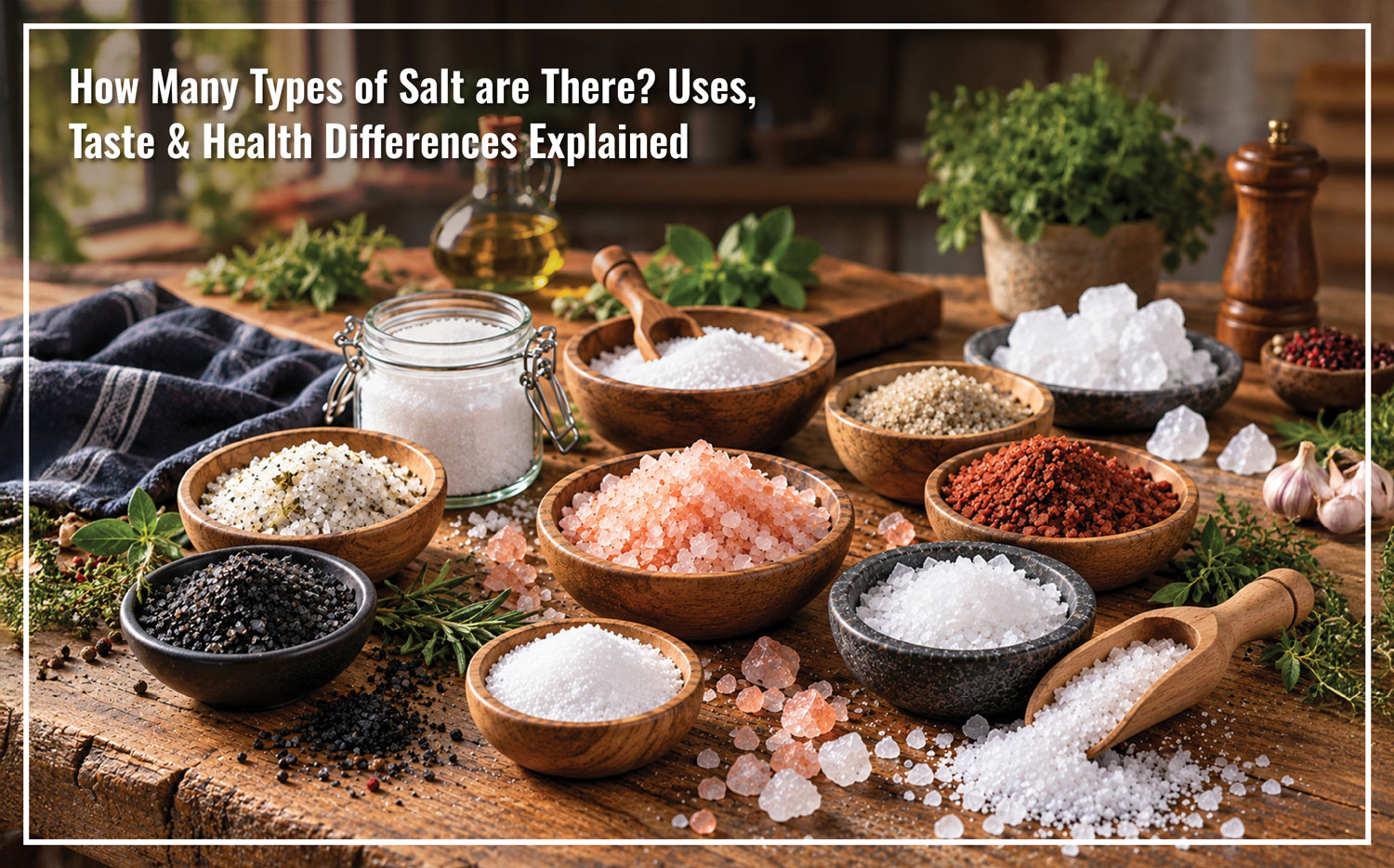
Ask five chefs and you’ll get five different lists honestly, that’s just how it goes with types of salt. But broadly it splits into two camps depending on where it comes from. Mined salt sits underground, a leftover from seas that dried up a very long time ago, we’re talking millions of years. Evaporated salt is newer in the sense that it comes from seawater or brine that’s been dried out, sometimes by the sun, sometimes in a big industrial pan somewhere. Table salt, kosher, sea salt, rock salt, pink Himalayan, kala namak, all the fancy finishing ones too, every single one of them traces back to one of those two origins and then gets pushed in a different direction depending on how it’s processed and how big the crystals end up.
That’s not just a fun fact by the way, it actually changes how you cook with the stuff. Crystal size decides how fast something dissolves and, this one trips people up, how much actually fits in a spoon. A tablespoon of kosher salt is not the same amount of sodium as a tablespoon of table salt, not even close, so if you swap one for the other in a recipe without adjusting you will notice, trust me. Mineral content shifts the color too and sometimes the flavor, though usually a lot less than the marketing on the jar wants you to believe. So when someone asks how many types of salt for cooking actually exist, I think the better question is which ones you’d reach for on a random Tuesday when nobody’s watching and you’re just trying to get dinner done.
Skip the heavy refining and you end up keeping over 80 trace minerals, magnesium, potassium, calcium, iron, the whole list. That’s honestly why organic salt looks different too, that pink or grey tint isn’t dye, it’s just minerals doing their thing instead of getting stripped out. A lot of brands slap “natural salt” on the label instead, and fair enough, it’s pretty much stayed the way it came out of the ground or the sea.
The Everyday Salt Types for Cooking
Table Salt
Most refined of the bunch, no contest. Mined, then stripped of pretty much every trace mineral, ground down into these tiny identical crystals that look almost fake up close. Most brands throw iodine in too, that goes back to the early 1900s when iodine deficiency was a real problem, and they add anti-caking stuff so it doesn’t turn into a solid brick the first humid week of summer, which, if you’ve ever left a container open near a boiling pot, you know happens fast. Because the crystals are so uniform it measures exact and dissolves almost instantly, and that’s exactly why bakers won’t touch anything else. Baking doesn’t forgive sloppy measuring the way a soup does.
This is what’s in my little dish by the stove, and honestly it’s what’s in most cooks’ dishes if you look. Bigger flakier grains, easy to pinch between two fingers, easy to actually see once it lands on the food so you’re way less likely to dump in double what you meant to. It dissolves clean too, no weird metallic edge some people say they get from iodized table salt. Out of everything on this list of types of salt for cooking people reach for constantly, this one wins by a mile, whether it’s going into pasta water, onto a steak right before the pan, or finishing off a sauce that needs one more pinch.
Sea Salt
Comes from evaporating actual seawater instead of digging anything out of the ground. Depending how it’s processed you get it fine or coarse, and it usually keeps a little more trace mineral content than table salt does, magnesium, calcium, potassium, that whole list, though honestly not enough to move any real nutritional needle, don’t let anyone tell you otherwise. What it actually changes is texture, and for some people there’s a faint taste difference too. Genuinely one of the more flexible types of salt out there because it works fine in the pot and just as well on top of a finished plate.
Mined out of old deposits in Pakistan, and that pink color comes from tiny traces of iron oxide, nothing more mysterious than that despite what some packaging implies. It gets marketed hard on mineral content but those minerals show up in such small amounts that nutritionally there’s not much difference between this and any other salt sitting on the shelf next to it. Where it earns its higher price tag is looks, plain and simple. Chunky pink crystals on a salt block or in a grinder photograph really well, and a lot of people, myself included honestly, buy it partly because it looks nice on the counter.
Rock Salt vs Sea Salt, What's Actually Different
I mixed these two up for years, not gonna lie. Both show up as rough gray-ish chunks in a bag and unless you’re actually reading the label you’d assume they’re basically the same thing. They’re not. Rock salt gets pulled straight out of the ground and doesn’t get refined much afterward at all, so what lands in your hand is big, jagged, sometimes dusty looking. Think about what it’s actually used for. Packing an old ice cream churn so it freezes evenly. Building a bed of ice under a plate of oysters at a raw bar. Getting thrown down on a driveway in January when everything’s iced over. A chunk of that in your soup would be a genuine mistake, and depending on the batch, some of it isn’t even food-grade to start with, which is a detail that surprised me the first time I looked into it.
Sea salt has nothing to do with any of that, it’s a completely different product made specifically to be eaten. It comes from evaporating actual seawater, not scraping something out of a mine, and the whole point of the process is ending up with something safe to eat whether it’s fine or coarse. So next time a recipe wants sea salt and the only coarse white stuff in your cabinet came from the hardware store, don’t. Just go buy the real thing, it’s not expensive.
Finishing and Specialty Salts
Beyond the everyday stuff there’s a smaller group that exists for one very specific job rather than general seasoning.
Organic Salt vs. Table Salt: A Quick Comparison
Fleur de Sel and Maldon Salt
You don’t cook with these, not really. They go on right before the dish hits the table. Fleur de sel is the fussier one, hand-scraped off the surface of salt pans in France by people who’ve apparently done it the exact same way for generations, which I think is kind of cool actually. Maldon’s the one you’ve probably seen before, that English brand with the wide papery flakes that crunch instead of dissolving. Put either one on a warm cookie or a steak straight out of the pan and you’ll get it immediately. Stir it into a marinade instead and you’ve basically wasted good salt, all that texture just disappears into the liquid and does nothing for you.
Smoked Salt
Pretty much exactly what it sounds like, salt that’s been smoked over wood, usually oak or hickory. Comes out carrying that campfire flavor without you needing to drag out an actual smoker or wait around for coals to get going. I use it on deviled eggs sometimes and people always ask what I did differently, and the answer is just, the salt.
The smell throws you off the first time, I remember opening a jar of this and immediately second guessing the purchase. Sulfurous, kind of like a boiled egg, not exactly appetizing on its own. But taste it in the right dish and it clicks fast. Vegan cooks especially swear by it because a pinch stirred into a tofu scramble genuinely tricks your brain into thinking there’s real egg in there, which sounds like a gimmick right up until you actually try it. There’s a religious side too that a lot of people outside South Asia probably don’t know about. During certain fasting periods, kala namak is one of the few salts considered acceptable to eat since it’s classified as a mineral salt instead of something processed like regular table salt.
Taste Differences Between Salt Types
Put a few side by side and taste them, you’ll notice real differences even though sodium chloride is basically all of every single one. Table salt hits fast and a little sharp, sometimes almost bitter, and part of that’s the anti-caking additives plus how densely those tiny crystals pack together. Kosher salt doesn’t do that, it dissolves slower since the crystals are bigger, so the saltiness rolls in gradually instead of smacking you all at once, which is probably why most people call it cleaner tasting even though it’s the exact same compound chemically.
Sea salt and pink Himalayan get talked about like they’re noticeably different from everything else and sure, maybe there’s a faint mineral note if you’re really paying attention. But blind taste tests keep coming back the same way, take the packaging away and most people genuinely can’t tell them apart, myself included if I’m being honest. Kala namak is really the only one that breaks this pattern, those sulfur compounds are strong enough you’d notice it blindfolded, no contest there. Maldon and the other finishing salts aren’t secretly saltier than anything else, they just deliver it differently, as a crunch you notice immediately instead of something that melts quietly into the background of a dish.
Health Differences, Sodium Content and Nutrition
This is where a lot of confusion actually lives, and I get why. Nutritionally nearly every common cooking salt out there, table, kosher, sea, pink Himalayan, sits around 97 to 99 percent sodium chloride by weight. The trace minerals people pay extra for in sea salt or pink salt show up in such tiny amounts you’d need to eat a genuinely dangerous quantity just to get any real benefit, and you’d hit unsafe sodium levels way before that happened anyway, so don’t go down that road.
What actually shifts isn’t the percentage by weight, it’s the sodium per teaspoon, and that comes down purely to crystal size and how tightly it packs together. Kosher salt crystals are bigger and looser, more air between the grains basically, so a teaspoon of it carries noticeably less sodium than a teaspoon of dense little table salt crystals. That matters if you’re watching sodium for blood pressure or heart reasons, because a recipe written around one salt can end up wildly over or under seasoned if you swap in another without adjusting the amount, which I learned the hard way once with a recipe that assumed table salt and I used kosher without thinking about it.
Kala namak deserves its own mention here too. It usually runs a bit lower in sodium chloride than refined table salt, thanks to its mineral makeup and whatever’s giving it that eggy smell, but that doesn’t make it a health food swap or anything close to it. Portion control still applies same as everything else.
If sodium’s something you’re genuinely managing for medical reasons, honestly the safer move is measuring by volume with the exact salt you’re using rather than assuming they all behave the same in a spoon, and reading labels when you actually can, since even iodized and processed salts vary between brands more than you’d think.
Which Salt Should You Actually Use When Cooking?
Here’s my honest answer, since it’s way too easy to walk out of a store with six jars of salt you’ll never actually finish, I’ve done it. If you only keep one type of salt in the kitchen, make it kosher. It’s forgiving, dissolves without fuss, works whether you’re measuring carefully or just eyeballing a pinch over the pan like most of us actually do. Table salt earns its spot for one reason, baking, since recipes are written assuming its exact density and swapping it out throws the whole ratio off. Sea salt’s worth keeping as a backup, it pulls double duty in the pot and on top of a finished plate. And if you actually care about finishing a dish properly, one small jar of Maldon or fleur de sel does the job, you genuinely don’t need a whole shelf of specialty salt for that.
Kala namak or smoked salt, only grab those if you’re actually cooking something that calls for them regularly. Otherwise that jar just sits in the back of your cabinet collecting dust, which is what happened to my smoked salt for about a year before I finally used it up.


FAQs
There’s no official count, but most kitchens use six to ten types of salt. They differ in how they’re harvested (mined or evaporated from seawater), how much they’re processed, and crystal size. These factors change how each salt dissolves, measures and tastes, so they aren’t fully interchangeable in recipes.
By weight, table, kosher and sea salt are all about 97–99% sodium chloride. By the teaspoon, kosher salt has less sodium because its larger crystals pack loosely. Still, none of these is a true low-sodium salt, so how much you use matters more than which type you pick.
Sendha namak (rock salt) is the salt most commonly used during fasts like Navratri, since it’s an unrefined mineral salt rather than processed table salt. Some households also use kala namak (black salt), which is popular year-round in chaat and raita.
Kala namak is often used in Ayurvedic drinks like jaljeera for bloating, but scientific evidence is limited. No salt has a proven digestive edge, and too much of any salt can do more harm than good. For ongoing digestion issues, consult a doctor or dietitian.
A bit of both. Kosher salt’s larger grains make it easier to season by feel, which is why chefs prefer it. The hype is a little exaggerated by TV, but the practical reason behind it is real.
Yes, plenty of people do. You just lose some control: baking may turn out slightly different, and you won’t get the crunch of a finishing salt. Add a second type only when you notice the difference.