Types of Salt for Cooking: A Complete Guide to Choosing the Right One
For years I had exactly one box of salt in my kitchen. Blue cylinder, pour spout, the works. Then one afternoon I wandered into the salt aisle of a specialty grocery store and just… stood there. Pink crystals. Grey flakes. Something labeled “volcanic” that I honestly still don’t fully get. It felt like overkill at first. But there’s a reason for most of it once you know what each jar is for. If a recipe tells you to use a specific kind of salt and you skip that part, or your food just tastes flat even though you swear you’re seasoning enough, it usually comes down to which types of salt for cooking you’re reaching for without thinking.
Here’s the breakdown. What the common types of salt actually do, where they earn their spot, and where you’re just paying more for a fancier jar.Somewhere between all these big decisions, we often forget a small thing we consume every day. Salt!
Why the Salt You Use Actually Makes a Difference
A teaspoon isn’t really one fixed amount, not with salt. Grain size changes how much fits into the spoon. Fine table salt packs in tight, so a level teaspoon ends up noticeably saltier than the same teaspoon filled with something coarse and flaky, because there’s more air between the crystals. That’s a big chunk of why a recipe built around one kind of salt can taste off if you swap in a different one and don’t adjust.
Texture’s part of it too, and people underrate this. Getting a feel for the different salt types for cooking changes how the whole dish comes together, not just how salty it ends up. Some salts disappear the second they hit a hot pan, gone completely. Others are supposed to stick around, meant to be noticed, that little crunch on top. Mix the two up and you’ll either under-season the inside of something or make the top taste like it washed ashore.
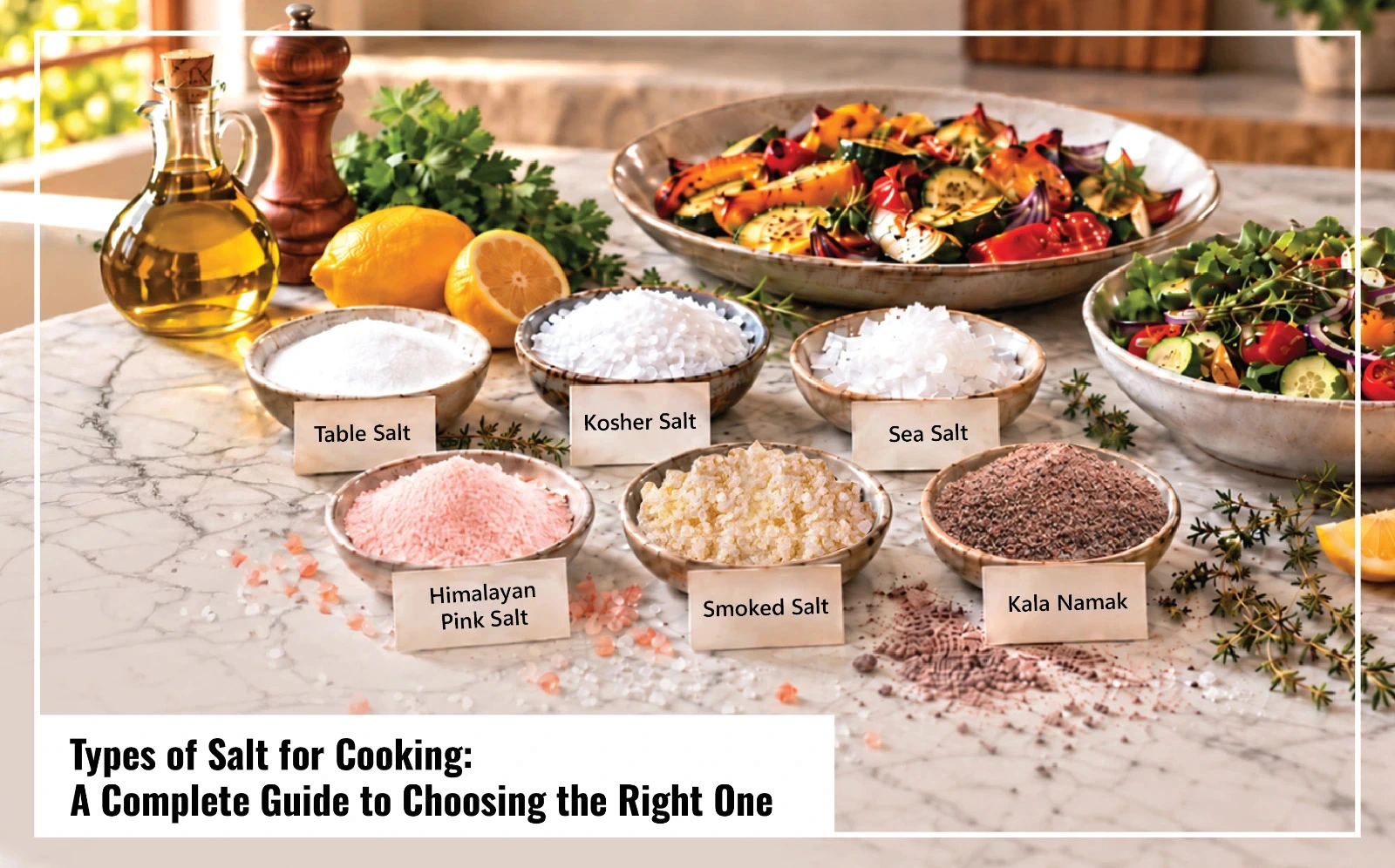
Table Salt
This is the one most of us grew up with. Fine, white, comes in that cylinder with the built-in spout. It’s mined, ground down into small even grains, usually treated with an anti-caking agent so it doesn’t clump when things get humid. Most brands throw in iodine too, going back decades to when iodine deficiency was an actual widespread problem.
Because the grains are so fine it dissolves fast and measures the same way every time, which is why baking recipes lean on it. It’s also the cheapest of the types of salt for cooking, not even close, so it earns a spot for pasta water or a big pot of soup.
Where it loses points is taste. A lot of cooks will tell you they can pick out a faint metallic edge from the additives. Part of why restaurant kitchens skip it for something plainer.
Kosher Salt
Watch pretty much any cooking show and eventually someone pinches kosher salt from a bowl and sprinkles it over a steak from up high. There’s an actual reason beyond looking good on camera. The grains are big, irregular, easy to grab between your fingers, so you feel exactly how much you’re using instead of guessing.
No iodine in most of it, usually no additives, and a cleaner taste than table salt. One thing worth knowing: since the crystals are bigger, a tablespoon of kosher salt weighs less than a tablespoon of table salt. Recipes that specifically ask for kosher salt mean it. Subbing table salt instead, cut the amount roughly in half.
If I had to keep just one salt in the house, this would be it. Dry-brining a turkey. Seasoning a steak right before the pan. Finishing a tray of roasted vegetables. It just handles all of it.
Sea Salt
Sea salt comes from evaporated seawater instead of a mine, and depending on processing the grain size can land anywhere from powder-fine to properly coarse. Because it comes from the ocean, it picks up trace minerals along the way, magnesium and calcium mostly, which is supposedly where the “different flavor” comes from. In practice? Pretty subtle. Don’t expect some big flavor revelation because the jar says sea salt in nice cursive.
Fine sea salt basically works as a drop-in for table salt in most recipes. The coarser stuff gets saved for finishing, over bread, a salad, a dish right before it leaves the kitchen. Out of all the salt types for cooking on a shelf, sea salt lands somewhere in the middle. More natural-tasting than table salt, but without the price tag of the specialty finishing stuff.
Himalayan Pink Salt
Mined out of ancient deposits in Pakistan, this one gets its pink color from trace iron oxide, really just a fancy way of saying a little bit of rust. It’s become a wellness trend at this point, with mineral-content claims that sound impressive until you notice the amounts are too small to do much nutritionally. On the plate, it acts almost exactly like any other salt, worth remembering before you drop extra cash on one of the pricier types of salt for cooking purely for the color.
Where it does earn its place is presentation. Coarse Himalayan salt looks great in a grinder on the table, and salt blocks cut from those deposits get used to cure food, chill it, or grill right on top of the slab. The finely ground stuff works basically like table salt. Just a little milder.
Fleur de Sel and Other Finishing Salts
Fleur de sel, French for “flower of salt,” gets hand-harvested off the surface of salt ponds, one of the pricier, more delicate types of salt out there. The flakes are light, melt slowly on your tongue, which is really the whole point. Sprinkle it on right before eating. Dark chocolate. A sliced tomato. A steak off the grill. Never cook with it directly, heat wrecks the exact texture you’re paying for.
Maldon falls into a similar bucket. Those pyramid flakes give a satisfying crunch and show up on caramel, roasted vegetables, grilled fish. None of these finishing salts are meant to replace whatever you cook with day to day. Think of them as the last five seconds of a dish, not an actual step in the recipe.
Rock Salt and Kala Namak
Rock salt is about as unprocessed as salt gets. Big, coarse chunks, used more for what they do than how they taste. Shows up around ice cream makers, as a bed for baking oysters, scattered on an icy driveway in winter. Nobody’s putting this directly on dinner.
Kala namak, or black salt, is a totally different animal. Staple in South Asian cooking, known for a distinctly sulfurous smell and taste from trace compounds formed during processing. That “eggy” quality is exactly why it shows up so often in vegan cooking, used to mimic actual eggs in tofu scrambles. Most kitchens outside that tradition probably never need it. But if you cook Indian or Pakistani food with any regularity, it’s close to a must-have.
Smoked Salt
Pretty much exactly what it sounds like, salt slowly smoked over wood until it picks up a deep, campfire kind of flavor. Handy shortcut for smokiness when you don’t have an actual smoker around, works great on grilled meats, roasted potatoes, even a deviled egg. A little goes way further than you’d guess, so ease into it the first time.
How to Actually Choose Between All These
With this many salt types for cooking and fighting for cabinet space, owning every single one is kind of pointless. Keep it simple. Kosher salt for everyday cooking, a flaky finishing salt right before something hits the table, maybe a coarser sea salt for baking or brining. That short list covers most of what happens in a normal home kitchen.
The real question is what job the salt needs to do. Dissolving into a soup, a sauce, a batch of dough? Go fine. Sitting on top where you actually want it noticed, a steak, a salad, a piece of chocolate? Go coarse, go flaky. Matching the salt to the job, instead of grabbing whatever’s closest to the stove, is the whole trick behind understanding the types of salt for cooking once you stop overthinking it.
The Bottom Line
None of this needs to be complicated. It does reward a little attention, though. Once you actually know what separates table salt from kosher salt, and a finishing flake from an everyday staple, picking between the types of salt for cooking stops being a guessing game at the store. Start with kosher salt as your workhorse. Keep something flaky around for the finishing touch. Let the rest build up naturally as your cooking gets better.


FAQs
1.What are the main types of salt used in cooking?
Most people really only need four of these. There's table salt for everyday stuff, and then kosher salt, which chefs tend to grab since the bigger grains are easier to control. Sea salt sits in the middle somewhere. And Himalayan pink salt, which is mostly there for the color on your countertop, not because it tastes that different. Those are really the core types of salt for cooking. Beyond that you've got fancier finishing salt like Maldon, and specialty ones like kala namak if you're cooking South Asian food. You really don't need to own all of them though.
2.Which salt is best for everyday cooking vs garnishing?
Out of all the salt types for cooking, kosher is what most people reach for day to day. The grains are big enough that you can actually feel how much you're pinching, so it's harder to dump in too much. Garnishing is a totally different thing. You want something flaky like Maldon that sits on top of the food instead of dissolving into it. Add it right at the end, or you lose the crunch. So basically, kosher while you cook, flaky salt right before you eat.
3.What is the difference between rock salt and sea salt?
Rock salt is dug up from the ground in these big rough chunks and barely touched after that, processing-wise. People don't really eat it plain, it's more for things like packing an ice cream maker or making a bed for roasted oysters. Sea salt is different. It comes from evaporating seawater and it's actually meant to be eaten, either in your food or sprinkled on top after. It's one of the more flexible types of salt out there.
4.Is black salt used in cooking or only for fasting?
Turns out it's both, and that trips a lot of people up. Kala namak goes into chaat, raita, and a lot of vegan cooking because of that eggy, sulfur smell it has. It's also one of the salts people eat during fasting periods in South Asia since it counts as a mineral salt instead of a processed one. So no, it's not just a fasting ingredient. Plenty of people cook with it normally too.
5. Do I actually need finishing salt, or is that just something brands invented to charge more?
I thought it was a scam for the longest time, ngl, figured salt is salt and Maldon just has better branding. Then a friend sprinkled some on tomatoes at a barbecue and I actually noticed the crunch, it doesn't dissolve in the same way regular salt does. That's really the whole point of it though, not flavor exactly, more texture. Out of all the types of salt for cooking sitting in a kitchen, finishing salt is the one you can skip without your food actually suffering. It's nice to have around but nobody's dish falls apart without it.
6. Can I use kosher salt in baking, or does it have to be table salt?
You can, just don't do a straight swap by the teaspoon or you'll end up with something under-salted, I did this with a cookie recipe once and couldn't figure out why it tasted flat. Kosher salt's grains are bigger, so the same spoonful actually has less salt packed into it. When a recipe just says salt without specifying, I've started weighing it out instead of guessing, saving the guesswork entirely. Out of the types of salt for cooking people keep in a normal kitchen, table salt still wins for baking purely because it measures the same every single time.