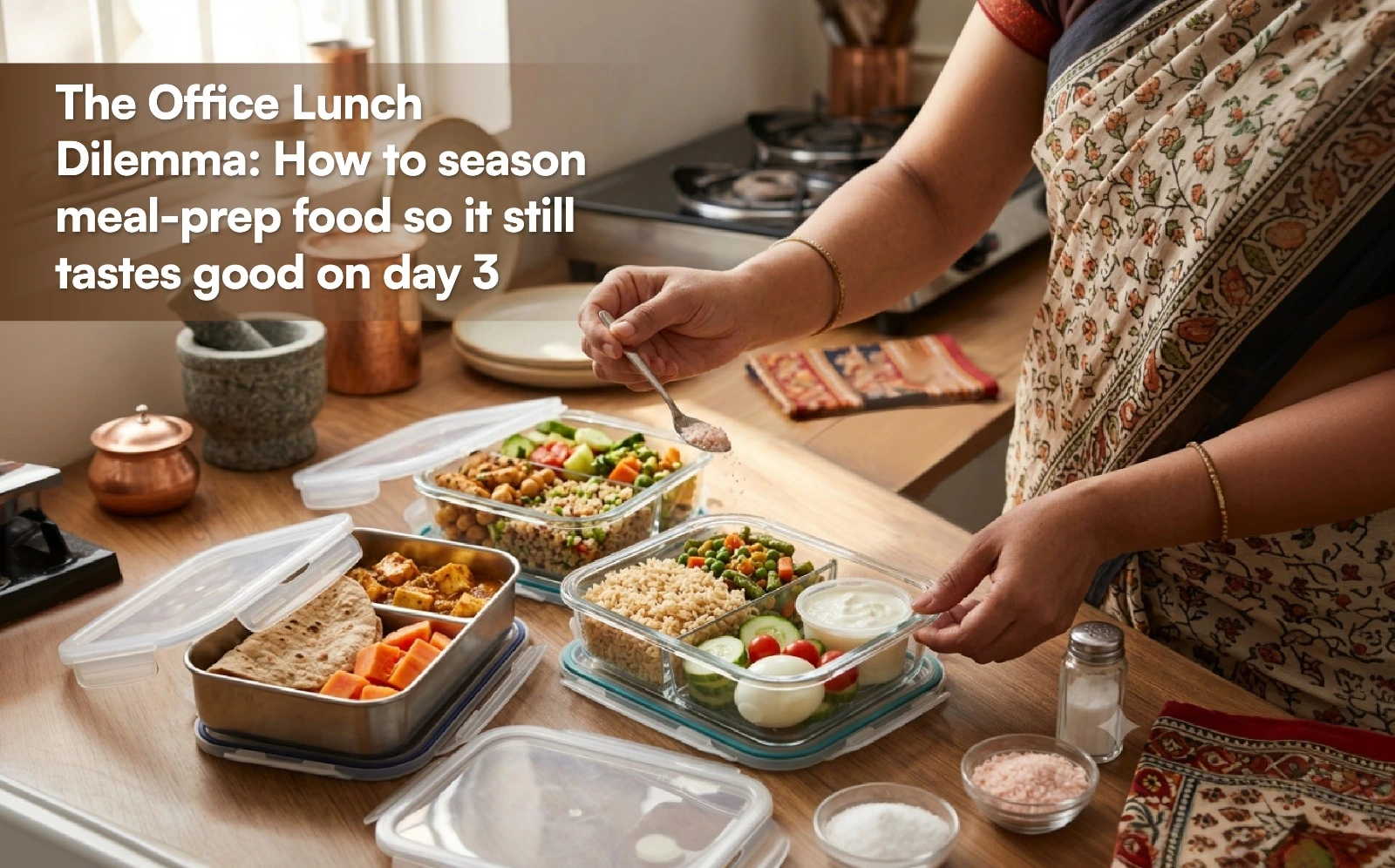
The Office Lunch Dilemma: How to Season Meal-Prep Food So It Still Tastes Good On Day 3 Meal prep sounds great in theory. Cook everything on Sunday, pack your lunches for the week and never worry about what to eat ever again. But realistically, eating the same meal five days in a row can get boring, and the planning becomes a task you dread. The trick is to make meal planning work around your life, rather than planning your life around meals. Don’t Complicate It Start small. Cook a little extra at dinner and pack the leftovers for lunch the next day. Going out for dinner? Order enough to save a portion for tomorrow. It is a simple way to reduce cooking time without adding another task to your day. You can also prep ingredients instead of complete meals. Keep staples such as dals, rice, potatoes, chicken, carrots, peas and anything else that you like ready in the refrigerator. Then mix and match them through the week. Make Seasoning Do The Work The easiest way to make meal prep interesting is to play around with the spices you use. A basic chicken and rice combination can taste completely different with a new sauce. Try herbs with natural salt one day, a soy-based dressing the next or black salt for a distinctive flavour. Understanding the different types of salt can help you add variety to everyday meals. Now that you know how salt affects taste, let’s look at some simple ways to use salt for bitter food. When exploring types of salt for cooking, think about the dish and the flavour you want. Rock salt works well in everyday preparations, while sendha namak can add a different flavour profile to simple dishes. Organic salt can also be an option for those looking to explore different varieties of salt for their kitchen. Knowing your salt types for cooking can make even familiar meal-prep ingredients feel a little more exciting. The right types of salt for cooking bring out the natural flavours of simple ingredients. Use natural salt for everyday dishes,when you want a distinctive taste and rock salt where you want to play with texture. Build A Complete Lunch A nutritious lunch does not have to be elaborate. Add chopped vegetables, fresh fruit, a boiled egg or dahi alongside your main dish. You can also experiment with different salt types for cooking. Even a simple salad, boiled egg or bowl of rice can feel more satisfying with thoughtful seasoning. Remember, you do not have to plan all seven days at once. Start with two or three meals, see what works and build from there. Keep rock salt or sendha namak handy when you want to switch things up and give familiar meals a different flavour. Meal prep isn’t about making every meal perfect. It’s about making everyday eating easier. With the right ingredients, a little planning and a good understanding of types of salt, even day-three lunch can still taste fresh. Sehat Ki Chamak. Table Top Namak.
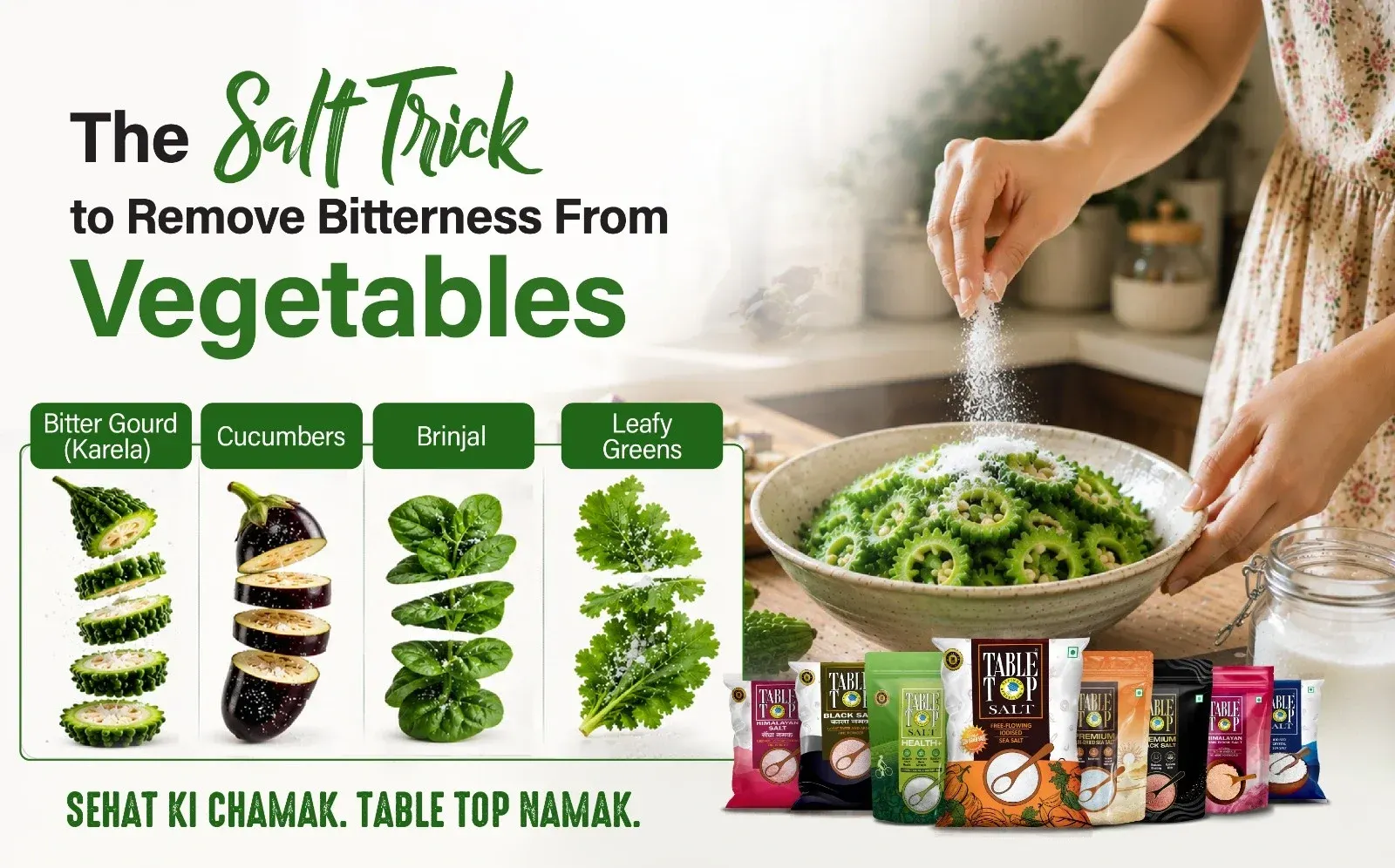
The Salt Trick To Remove Bitterness From Vegetables
The Salt Trick To Remove Bitterness From Vegetables Do vegetables always end up being the last thing on your plate? Do you want the health benefits of vegetables but not the bitter taste? There’s a simple fix, and it’s already in your pantry. Salt! Most people think of salt as a simple seasoning, but it does so much more. It enhances flavour and helps tone down the bitterness, making vegetables more delicious. How does Salt Reduce Bitterness? If you’ve ever wondered, why does salt reduce bitterness? It’s all in how salt taste receptors work. Salt reduces bitterness by blocking taste signals that make the food feel bitter. Even a small amount of salt can make vegetables taste milder. Salt also helps bring out the natural flavours in food, making their sweeter and more pleasant flavour stand out. This is why food becomes more enjoyable to eat after being lightly salted. Salt and bitter taste are connected in more ways than one. Salt improves the texture of certain vegetables, making them more enjoyable and tricks the brain into enjoying it. How Salt Enhances Flavour in Bitter Vegetables Now that you know how salt affects taste, let’s look at some simple ways to use salt for bitter food. ● Bitter Gourd (Karela) Slice the karela, scrape out the white pith and generously rub it with Table Top rock salt or sea salt. Then, place it in a covered bowl and leave it for about 30 minutes. Wash off the salt and firmly squeeze out the dark liquid. This helps remove some of the bitter compounds, leaving the karela milder in taste. ● Cucumbers Cut off both ends of your cucumber, especially the stem end where most of the bitterness is concentrated. Sprinkle a little salt on the cut end and rub it against the cucumber in a circular motion until a white foam appears. Wipe the foam away, rinse, peel and enjoy, ● Brinjal Cut the eggplant into slices or cubes, sprinkle a generous amount of salt over both sides. Leave it for 20 to 30 minutes. The salt will draw out excess moisture along with some of the bitter compounds. Rinse under cold water, pat it dry and then cook. This also helps the vegetable absorb less oil. ● Leafy Greens (Palak, Mustard Leaves) If you are eating palak raw, sprinkle a little salt over the chopped greens and gently massage till the leaves soften. If you want to eat it cooked, boil the greens in salted water for 3 to 5 minutes, then drain them. This helps remove some of the bitter compounds, resulting in a milder flavour. Why Choosing the Right Salt Matters? Salt is one of those kitchen essentials that we use every day without giving it much thought. Yet, it plays a bigger role than making food taste better. From balancing flavours to reducing bitterness, the types of salt for cooking you choose can make a difference to your dishes and health. Table Top Salts stands out as a trusted choice for everyday cooking. Choosing the right salt types for cooking can help enhance flavour, improve texture and bring out the natural taste of your ingredients. The right salt elevates every meal. The history of Indian dishes was never written in polished cookbooks. It was written in these ordinary meals that carried an entire nation through its most challenging days.
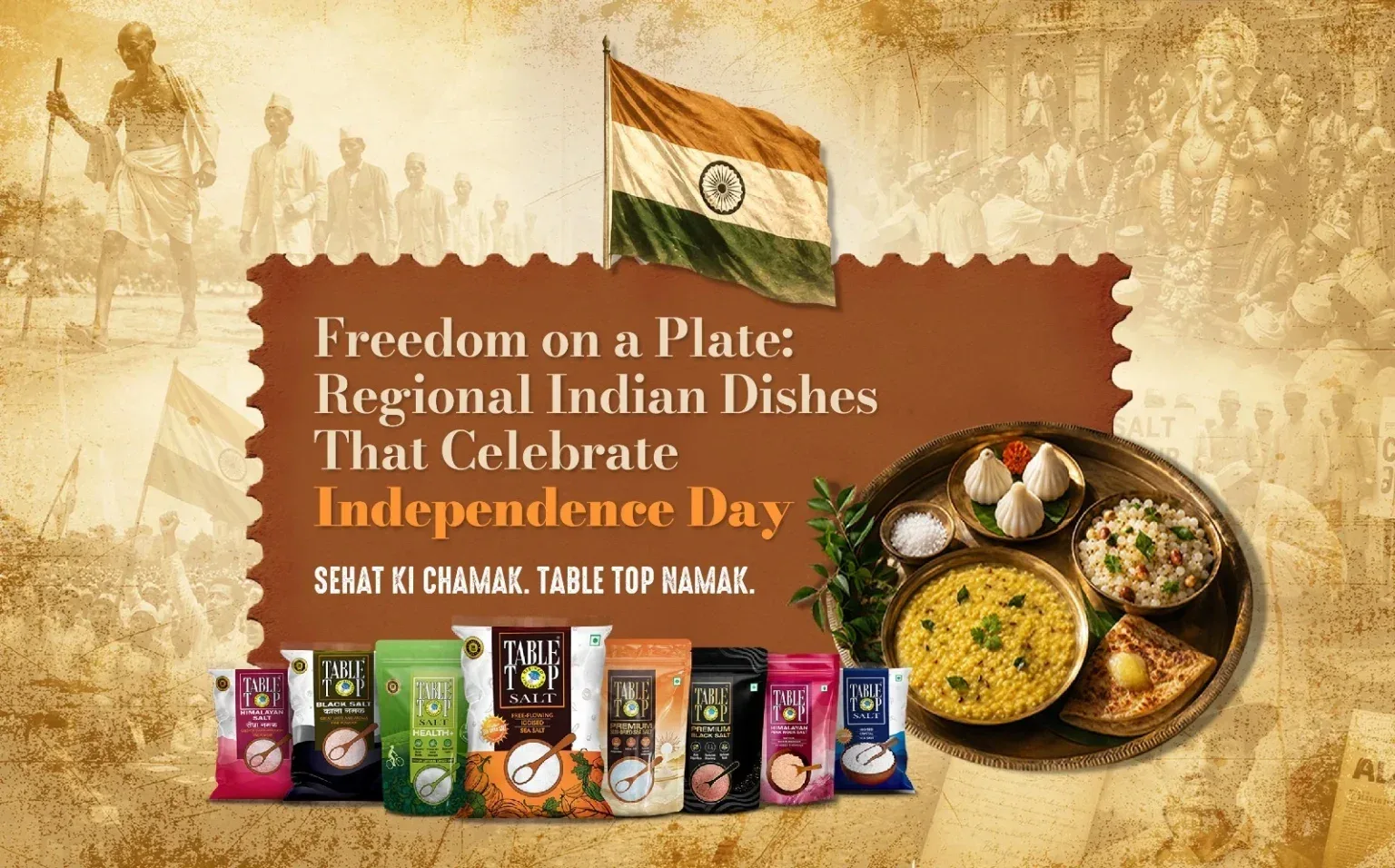
Freedom on a Plate: Regional Indian Dishes That Celebrate Independence Day
Freedom on a Plate: Regional Indian Dishes That Celebrate Independence Day There is something quietly moving about the food that shaped India’s fight for freedom. It was never about grand feasts or elaborate menus. It was about resilience, simplicity and the will to keep going even when resources were scarce. So, this Independence Day, before reaching for the usual saffron rice and tricolour desserts, it is worth pausing to understand the foods from India’s freedom movement that carry far more history than most of us realise. Khichdi is a fitting place to begin. During the freedom struggle, community kitchens relied on it to feed hundreds of protestors and prisoners at once, since rice and lentils cooked together in one pot could stretch to nourish hundreds with just a handful of humble ingredients. It was never about taste back then. It was about nourishment and endurance. Even today, khichdi remains one of those traditional Indian dishes that has never really left our homes, no matter how many new cuisines have entered our kitchens since. Sabudana khichdi holds an equally important place in this story. Many freedom fighters observed religious fasts even while continuing their protests and this light, tapioca- based dish gave them the energy to keep going without breaking their fast. It is a humble dish but one that carries both devotion and determination in every spoonful. No conversation about Indian Independence Day dishes would be complete without mentioning salt. In 1930, Mahatma Gandhi marched to Dandi because the British had taxed something as essential as salt and that single act of injustice became the spark for one of the most powerful protests in history. Producing salt from seawater with one’s own hands became a quiet yet defiant act of resistance. It is worth remembering that someone once walked nearly two hundred and forty kilometres simply to reclaim the right to make it. This history is perhaps why the idea of pure healthy salt feels closer to our roots than we often acknowledge. There is something deeply grounding about sun dried salt, prepared slowly under the sun in coastal salt pans, much as it may have been during those very protests. No shortcuts and no artificial processes, only patience and a natural method passed down through generations. Salt has also evolved to meet the needs of a changing India. Today, double fortified salt is helping address iron and iodine deficiency in many rural communities across the country. In many ways, it feels like a continuation of the same spirit of resilience, except this time, the struggle is against malnutrition rather than colonial rule. Even festive food played its part in this larger narrative. In Maharashtra, Bal Gangadhar Tilak transformed Ganesh Chaturthi into a large public gathering and dishes such as modak and puran poli became part of a celebration that was quietly also an act of unity against British rule. Food, once again, became a gentle yet powerful form of resistance. This is the true essence of Indian heritage food. It is not simply about flavour or presentation. It is about how our grandparents and freedom fighters found comfort, strength and courage in the simplest of meals during the most difficult of times. So, this Independence Day, consider looking beyond Independence Day special food that is designed only to look patriotic. Cook something that carries genuine meaning, perhaps a pot of khichdi or a bowl of sabudana khichdi if you are observing a fast and season it with a pinch of good, honest salt. That single ingredient quietly earned its place in our kitchens long before most of us understood its true worth. The history of Indian dishes was never written in polished cookbooks. It was written in these ordinary meals that carried an entire nation through its most challenging days.
Salt at the Start vs End of Cooking: How It Changes Texture and Flavour
Salt at the Start vs End of Cooking: How It Changes Texture and Flavour Every family has that one person who cannot stop tasting the food while cooking. The curry is simmering, dinner is twenty minutes away and they have already tasted it five times. They are standing at the stove with a spoon in one hand and zero plans to stop. In most Indian homes, this person is a parent and honestly, everyone already knows what comes next. “Something is missing.” The salt container opens before the sentence is even finished. For something that spends its entire life sitting quietly in the kitchen corner, salt manages to create a remarkable amount of drama. Too little and someone notices at the first bite. Too much and the family discusses it through the entire meal. Forget it completely and that one incident somehow survives in conversation for years. Most people only understand this after they start cooking on their own. The recipe is followed carefully, the ingredients are right and the dish looks exactly as it should. But it still does not taste like home. The reason is usually something nobody thinks to ask about. Timing. Watch someone who has been cooking for decades and a clear pattern emerges. They are making small, almost automatic decisions throughout, for example, when to add salt while cooking. In curries, dals and sabzis, salt often goes in far earlier than most people would expect. Not because a recipe instructed them to do so, but because years at that stove quietly taught them what gets lost when they wait too long, one of the most valuable salt cooking tips a cook can learn. Nobody explains this while it is happening. They are usually occupied telling someone to step away from the pan. When salt is added early, onions soften more readily, vegetables release their moisture and flavours gradually settle into one another. It all happens in the background, without announcement, while the rest of the house goes about its day. Some foods, however, tell a different story entirely. Pakoras on a rainy evening, roasted potatoes that disappear almost immediately or cucumber slices where someone is insisting they will only have one piece. These do not need salt worked into them during cooking. They need it right at the end. A light sprinkle just before eating and suddenly every flavour feels sharper and more alive. This is where finishing salt vs cooking salt becomes two genuinely different conversations. One builds flavour gradually from within. The other arrives at the last moment and brings everything into focus. The types of salt being used matter here as well. Different salt types for cooking dissolve differently, distribute flavour differently and leave behind noticeably different results. Some disappear entirely into a slow-cooked curry while others remain distinct right until the final bite. Among the many types of salt for cooking found in Indian kitchens, fortified salt is the consistent everyday presence. It shows up in the hurried weekday dinner, the carefully made festive meal and the dish that has never existed as a written recipe because it has always lived in someone’s hands instead. But this is never truly just about salt. It is about the tasting spoon that never rests, the quiet debate over whether the sabzi needs one more pinch, the person who adds a final sprinkle after everyone agrees the food is ready and turns out to be right. These small, unhurried moments are what actually make a meal feel like something worth remembering. Because the difference between food that is simply good and food that genuinely stays with you is rarely about one dramatic ingredient. It is usually one small decision, made at exactly the right time, like knowing when to reach for the salt.
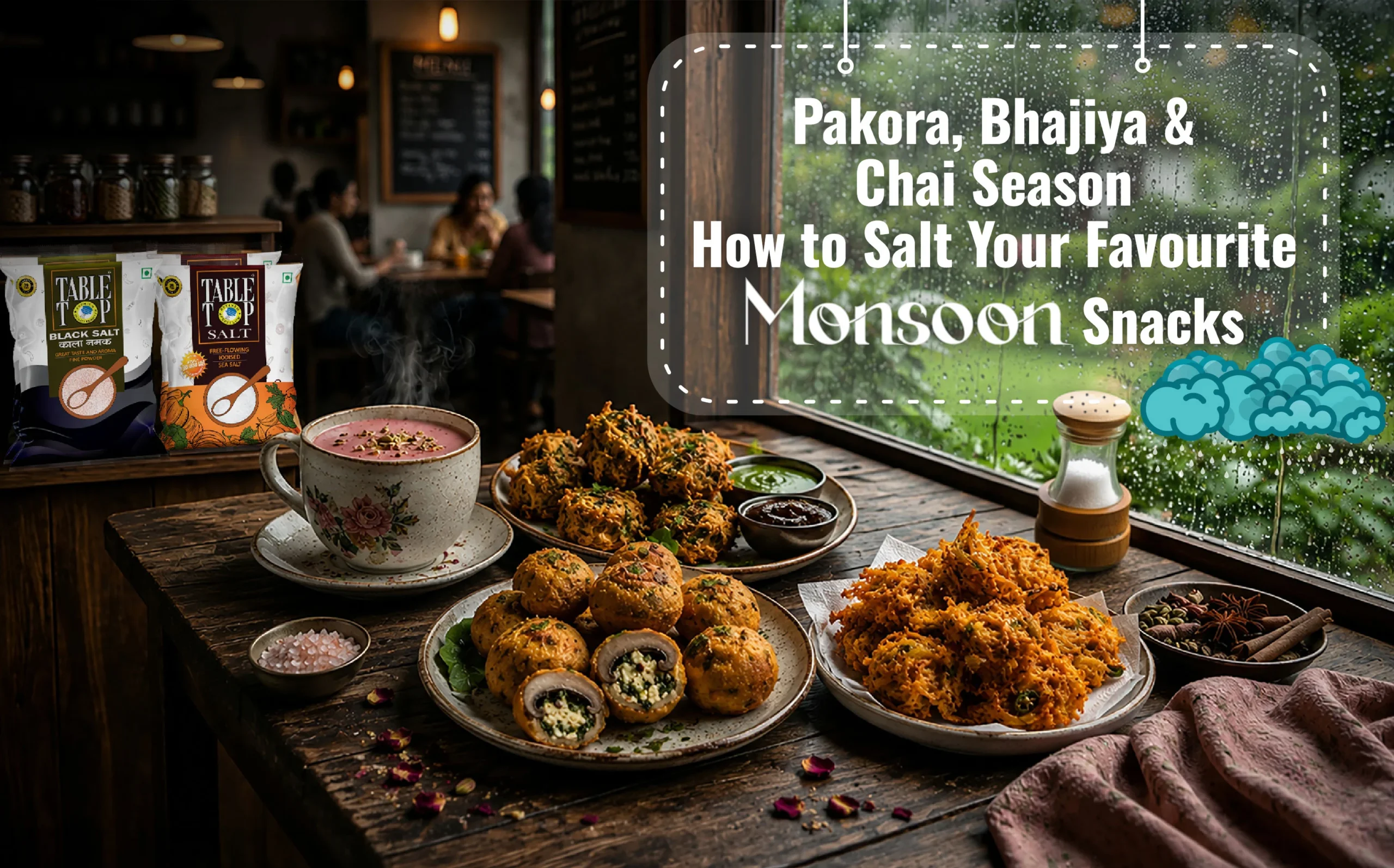
Pakora, Bhajiya & Chai Season — How to Salt Your Favourite Monsoon Snacks
Pakora, Bhajiya & Chai Season — How to Salt Your Favourite Monsoon Snacks A monsoon evening has magic that’s hard to explain. The muddy pants, the clogged roads, the wet floors, all of it fades the moment the workday ends and the evening is yours. You make the perfect cup of chai, pull a hot crisp pakora off the plate and suddenly the sound of rain is the only thing that matters. What makes the pakora crisp? What gives that chai its depth? More often than not, the answer is salt. Not just how much, but which kind. Most kitchens run on one type. But knowing your salt types for cooking changes things. Kosher salt is coarser and additive-free, preferred when you want a clean flavour and better control. Black salt (kala namak) is sharp and the secret behind every good chaat masala salt blend and street-side chutney. Rock salt is mild and packed with minerals. Fine table salt is ideal for batters since it dissolves fast and distributes evenly. The types of salt for cooking you choose can make or break a recipe, particularly one as texture-sensitive as a pakora. Here are some monsoon snack recipes to make your evenings more special. Noon Chai Most evenings call for adrak wali chai, but on some days when you want to slow down, try this savoury, rose-hued Kashmiri brew. Bring 2 glasses of water to a boil. Add tea leaves, one-fourth tsp salt, and some whole spices like 1 star anise, 1 inch cinnamon, 2 green cardamom pods. Once boiling, stir in one-fourth tsp baking soda; this is what turns the brew pink. Simmer, stirring constantly, until reduced by half. Add 1 cup ice-cold water and reduce again, for more depth. In a separate pan, boil full-fat milk with sugar to taste. Combine the decoction with the milk and simmer gently for 5 minutes. Serve hot, topped with crushed pistachios. The baking soda and salt work together to give Noon Chai its colour and its savoury edge. Try it with Table Top Black Salt for a subtle, earthy taste. Pakora If Noon Chai is for the days, and you have a little extra time, pakoras are for every day. It’s very simple, just some vegetable of your choice dipped in besan batter and fried. Here’s the thing about the best salt for pakoras: add it to the batter, not after. Salt draws just enough moisture from the vegetables to create steam during frying, which puffs the batter and keeps it light. This is the crispy pakora tip. Here are a few pakora combinations to experiment with this season. Spinach and Cheese Stuffed Mushroom Pakora Button mushrooms filled with spiced paneer and cheese, coated in seasoned chickpea batter. Use Table Top Iodised Crystal Salt/kosher salt to help cut the richness. Mix Veg Pakora A mix of thinly sliced onion, potato, and spinach goes into a well-seasoned besan batter with ginger, green chilli, and coriander. Salt the batter with regular table salt, keep the seasoning straightforward. Sprinkle some chaat masala & Table Top Iodised Sea Salt on it before serving with green and tamarind chutney. Pumpkin Pakora Grate red pumpkin and fold it into besan with carom seeds, green chilli, a pinch of turmeric, and red chilli powder. Season the batter with fine table salt for even distribution, and finish with a pinch of Table Top Black Salt right after frying. It helps cut through the sweetness and ties everything together. Most home cooks own one salt and never think twice about it. Remember, salt isn’t just seasoning, its texture, depth and finish all at once. Table Top Salt gives you a pure, carefully sourced range that covers every job in the kitchen, from batter to garnish. Our salt ranges are free from unnecessary additives and packed with natural minerals your body actually uses. Better salt, better food. Simple as that.

How Sodium Needs Change During Pregnancy, Menstruation and Menopause
How Sodium Needs Change During Pregnancy, Menstruation and Menopause There are certain moments when women suddenly become very aware of their bodies. The days during your periods when your jeans feel tighter for no reason. The strange pregnancy cravings at 2 a.m., where only salty food sounds comforting. The phase during menopause when foods you have eaten your whole life, suddenly stop feeling the same. And somewhere between all these changes, salt quietly becomes part of the conversation. Your mother telling you not to eat too many chips during your periods because it will make bloating worse. Your grandmother adding a little extra salt to homemade lemonade during pregnancy because “the body needs strength”. Your doctor casually mentioning sodium levels during a health check-up years later. The truth is, a woman’s sodium needs keep changing through different stages of life. During pregnancy, the body goes through an unbelievable amount of change. Blood volume increases, the body holds more fluids and swelling suddenly becomes normal. According to research published in Nature, sodium actually helps maintain fluid balance during pregnancy instead of being something women should completely avoid. That is why many families today are becoming more mindful about the kind of salt they use at home. Instead of depending heavily on processed foods loaded with excess sodium, many people now prefer low sodium salt options for everyday cooking. Products like Low Sodium & Double Fortified Iodised Sea Salt are also becoming common in modern kitchens because they help balance sodium intake while supporting iodine consumption too. And during pregnancy, iodine becomes especially important for thyroid health and the baby’s development. Then comes menstruation, the monthly experience almost every woman knows too well. You feel bloated and dehydrated at the same time. Your body craves salty fries, instant noodles and chaats even when they make you feel worse afterwards. Hormonal changes affect fluid retention during menstruation, which is why the body suddenly behaves differently for a few days every month. This is where many households are choosing fortified salt instead of relying too much on processed salty snacks. Fortified salt adds essential nutrients to everyday meals while still keeping food flavourful and comforting. And menopause? Nobody really prepares women for that phase either. Foods that once felt normal suddenly cause puffiness or discomfort. Blood pressure fluctuations become more noticeable. Even the body’s relationship with sodium starts changing quietly with age and hormonal shifts. That is one reason why Double Fortified Salt is becoming increasingly popular today. Since many women experience iron deficiency throughout different stages of life, Double Fortified Iodised Sea Salt helps support both iodine and iron intake in everyday life. But at its core, this isn’t just about salt. It is about how women spend their entire lives adjusting to bodies that are constantly changing. Learning what feels good, what causes discomfort and what helps them feel healthier through every phase. Health is not about removing everything enjoyable from your plate. It is simply about choosing pure healthy salt, cooking balanced meals and paying a little more attention to what your body has been trying to tell you all along.